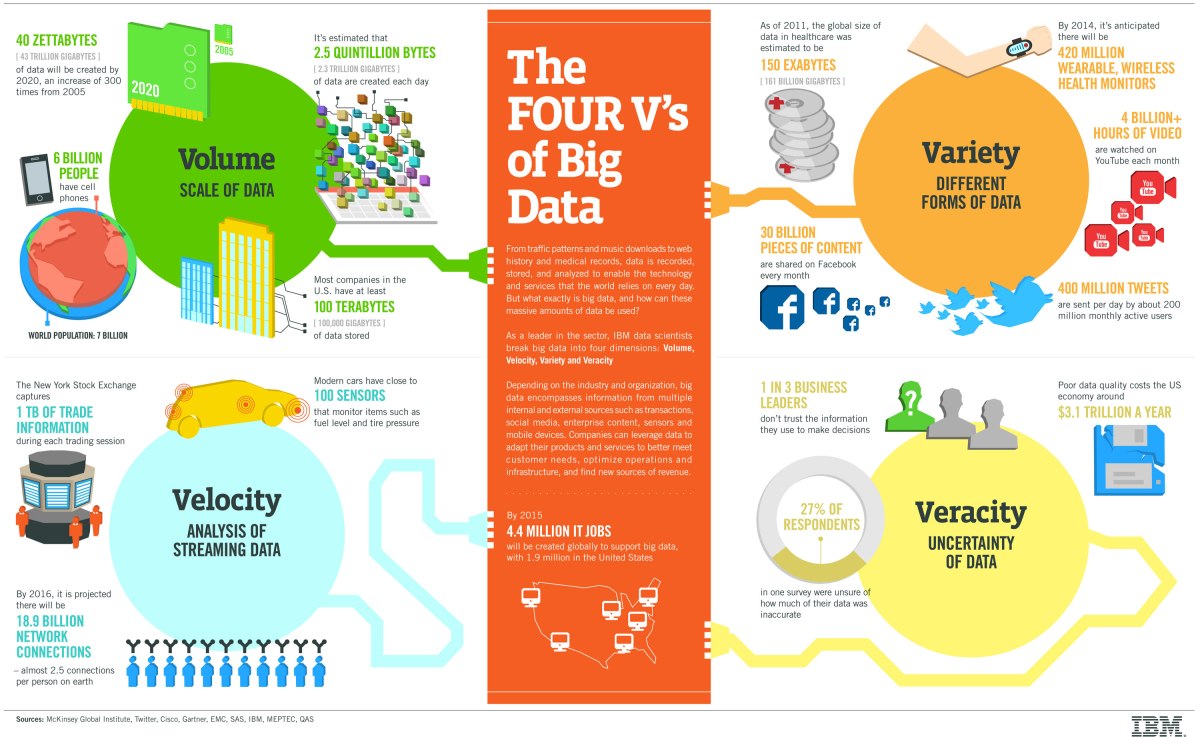
Companies glean a wealth of information about target markets and their behavior from their online activity, point-of-sale transactions, loyalty programs and public domain databases. However, simply accumulating data is not enough to gain a competitive edge. To do so, data must be used strategically, which is why big data is being leveraged by corporations of all sizes. IBM underscores the four V’s of big data namely :Volume, Velocity, Variety and Veracity in the info graph given below, each of which is undeniably crucial.
Traditionally, big data has been gathered and analyzed by the business intelligence units of companies, but the trend now is towards democratizing data in organizations so that all departments can develop strategies based on the analytics and insights available to them.
The Vice President of Prudential, Mark Hug came for a lecture to our class at NYU and explained the importance of big data in every industry in today’s world. He pointed out how he is working towards using big data to provide an estimate of insurance premium to its customers without the complicated process of conducting medical tests as well as making expensive trips to the houses of the insurance seekers. He said that the customers will only have to provide their social security numbers and the company would give an estimate within a couple of seconds. This has been made possible only because of the fact that Prudential would have a mammoth of big data – access to every transaction made by the consumer, the websites visited, the logs of the bills at medical stores, doctor visits as well as purchases made at grocery stores. This data directly correlates to the medical conditions of the insurance seeker and would thus help in estimating insurance premiums. This is the power of big data. Hence, big data helps understand consumer behavior, in order to create constructive, long lasting, strategically focused marketing strategies that are results driven and goal oriented.
My concern with big data is privacy. It makes me feel like someone is invading my privacy all the time and nothing, virtually nothing is personal. Whether companies use this data to retarget ads or even use data to provide me information about what I could also like to buy after making a purchase on Amazon, it makes me feel predictable and that’s also what I don’t like.

We cannot trust every bit of data because there are several metrics behind every transaction, search or purchase made online. May be I read up about cancer for my friend, may be I purchase medicines for my aunt, may be someone else accesses my laptop – there are too many dynamics to the diverse transaction, so data cannot and should not be analyzed independently. One needs to articulately combine data with personal judgment, analysis , past experience, competitive landscape as well as a degree of intelligence and gut in order to take prudent marketing decisions. Hence, I believe one cannot take decisions only based on past data, it needs to be correlated with other parameters, keeping the future changes in demographics and psychographics in mind.
 Bhavini Khullar