The 5 Essentials For Your Digital Stratgey

Digital Marketing has escalated to a quintessential pedestal in our daily lives. It has become the oxygen we breathe, the new vitamin we need, the elixir to our lives and the daily workout we need to exercise our nimble fingers. Whatever it may be, we cannot escape it and hence, it becomes imperative to chalk out our digital strategy in a systematic, chronological manner.

Here are the 5 essentials for your Digital Strategy:

1.Data analytics is key:

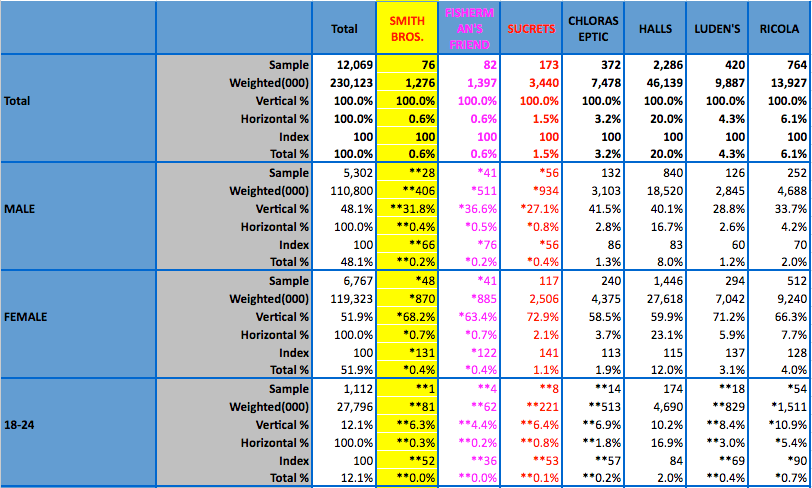
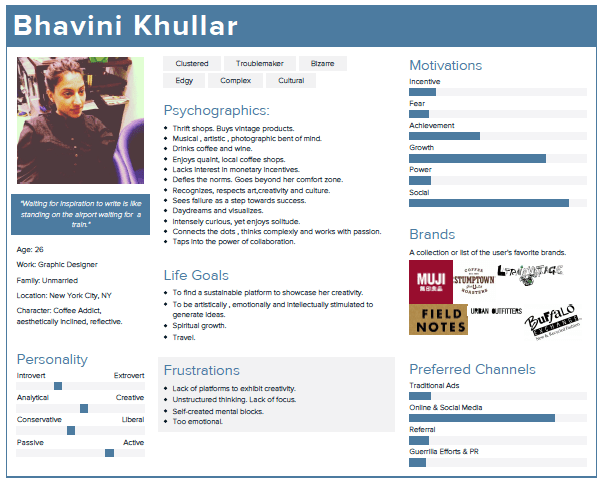
The value of data cannot be overemphasized; it is what defines the digital strategy. First it is essential to have a clear understanding of our target audience using databases such as Simmons/MRI.Having complete information about the customers is critical – Where they live, what they eat, where they dine, whether they have pets, what they do in their free time.This helps us find customer insights and helps us create customer profiles. Upon the completion of customer insights, effective strategies can be created. This includes strategic partnerships as well as the curation of statistical models for media buys.
Screen Shot 2016-04-30 at 2.11.54 PM
A Simmons Run to study the Gender and Age of the Target Audience as opposed to the Competitors.
Screen Shot 2016-04-28 at 10.46.11 PM
The creation of Customer Personas based on the Demographics and Psychographics of the Simmons Run.
Screen Shot 2016-04-30 at 2.21.10 PM
The creation of a Strategic Media Buy based on the Customer Insights.

Hence, this data driven process helps us define the amount of money that would be feasible towards an effective Digital Strategy, with a lucrative ROI.

Data is also essential when strategies pertaining to improving the clicks, impressions, bounce rate , average time spent have to be developed. These offer KPI’s to our digital campaigns. For example, the KPI for e-mails is open rate, hence it becomes essential to configure the current open rate as well as the Industry’s Open rate, in order to create a goal, which should be reasonable and achievable.

For example, one can use Similar Web to decipher the several statistics pertaining to a site, in order to set KPIs post campaign and to even understand how to allocate the funds in the digital strategy – whether to improve the bounce rate, or to increase the impressions and by how much.

Screen Shot 2016-04-30 at 2.26.53 PM
SimilarWeb provides a Snapshot of how the engagement metrics in Zara currently look.

2. User Experience:

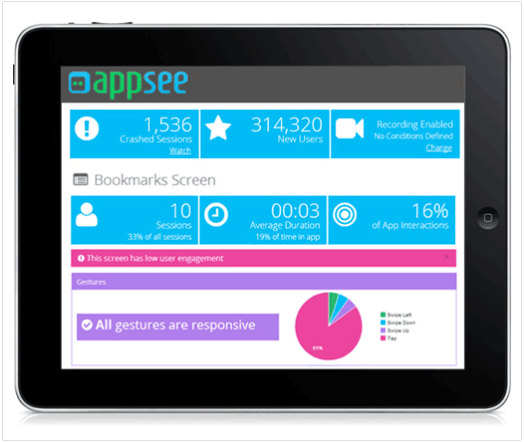
User experience has grown volcanically. Its has transcended beyond the layout, font, text, speed and the look of the website. Tools such as Appsee can be used to measure the user experience of apps using tools such as heat maps and helps create more user friendly , less complicated web layouts on the mobiles as well as the destops.

Screen Shot 2016-04-30 at 2.46.11 PM
Appsee, used to measure the UX of Apps using several tools such as engagement and heat maps.
Screen Shot 2016-04-30 at 2.42.05 PM
Heat maps help monitor the traffic and helps understand where the eyeballs are most probable to look.

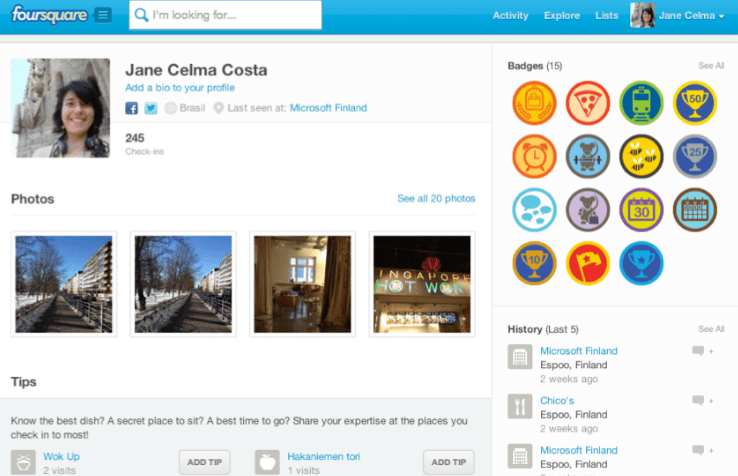
User Experience has to be made more interactive and is now encompassing tools like gamification, which stimulate customer interaction with the brand and make it more interactive and engaging. These apps provide levels and scores to the users, adding an element of fun and competition among the users. For example, Foursquare uses gamification on its app by providing levels to the users in order to be able to share the status on social media as well as map the performance in order to engage the customer even more.
Screen Shot 2016-04-30 at 2.53.38 PM
Gamification used by Foursquare – Swarm provides 


3. Content is still king:

The objective of a content strategy is to produce content and distribute it through various channels in order to create engagement among the target audience.

There are several formats of content curation such as blogs, videos, emails, podcasts, social media, white papers , audio formats and the list goes on. These snippets of crisp information enhance the value of the brand and create more authenticity and trust in the company. Companies also employ the concept of native advertising through content. This means talking about the product in a story telling format and creating the need in the mind of the consumer.

The goal is really to position the brand as an “innovator”  in the given field and build enrichment, faith and engagement.

Content marketing is about penetrating into the everyday life of the target audience.

Here are a few examples of exemplary content strategies displayed by companies.
Screen Shot 2016-04-30 at 3.09.54 PM
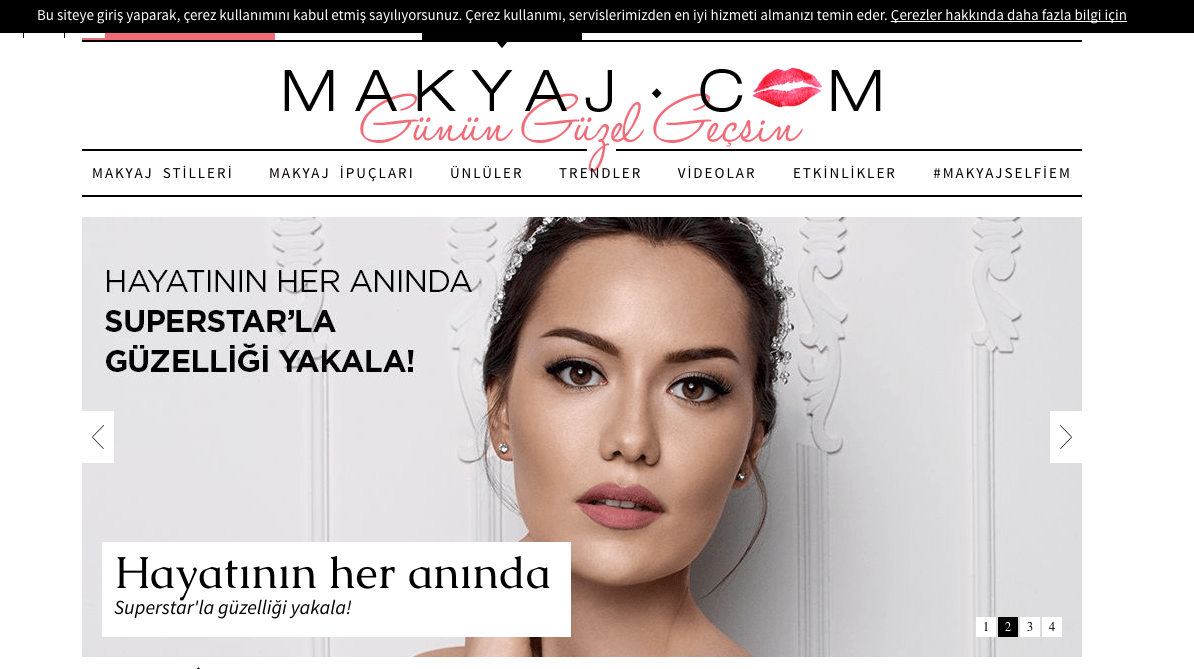
Turkish Content page for beauty ( sponsored by L’oreal)

Burberry, too has pioneered the art of creating effective content strategies. Its Youtube channel provides help content to its customers and answers questions pertaining to styling options and how to pair clothes. The YouTube channel creates Acoustic versions of songs, penetrating into the everyday lives of the target audience in order to be more relevant. Brands are now going beyond what they create and have a more holistic approach towards their consumers.

4. Mobile Marketing:

2015 was the first year that mobile traffic exceeded that of desktop users. Target audiences are now going after their mobiles phones before they reach out to their desktops and hence with the emergence of apps that have literally taken over the individuals by a storm it is essential to have apps wherever applicable and at least have a mobile optimization strategy. Brands are now blurring the differences between social and e-commerce and hence it has become important to be on social media channels and use apps such as Snapchat, especially if video is a platform that can enhance the user experience.

shop-now

Well-known social platforms are taking their awkward first steps into becoming shopping centers.
Image Source: Adweek

Mobile Ad Networks Worth a Look

With this new medium gaining in popularity by leaps and bounds, it’s no surprise that a handful of mobile-friendly ad networks have cropped up to take advantage of tech-savvy surfers. Some of the largest and most highly recommended networks include:

jumptap

Jumptap – One of the largest mobile advertising networks, Jumptap holds patents on many innovative types of mobile content monetization and targeting technology.

admob mobile network

AdMob – Google’s mobile ad service, AdMob integrates advertising within apps to let content publishers and app developers earn money and expand their reach.


5. Omni channel Marketing:

Omni channel marketing is a brand experience created to reach the target audience across as many marketing channels as possible.Google reports that 90% of consumers move between devices and channels when making a purchase.These marketing channels include: websites, email, social media, print, aerial advertising, mobile apps, the physical store or even a catalog via devices such as phones, laptops, TV. Hence, it becomes necessary to integrate these channels with the devices to create a smooth brand omni channel experience.

Here is an example of how Macy’s has very successfully implemented its omni channel marketing strategy, in order to reach out to customers across platforms and different media.

Hence, the above are the 5 most essential components for an effective digital strategy which are a complete must haves for any company across any industry in order to be successful in the digital space.

The Omnipresent Omni-Channel Marketing

Omni channel marketing is not a practice, but the creation of a mindset. It is a brand experience created to reach the target audience across as many marketing channels as possible.Google reports that 90% of consumers move between devices and channels when making a purchase.These marketing channels include: websites, email, social media, print, aerial advertising, mobile apps, the physical store or even a catalog via devices such as phones, laptops, TV. Hence, it becomes necessary to integrate these channels with the devices to create a smooth brand omni channel experience.

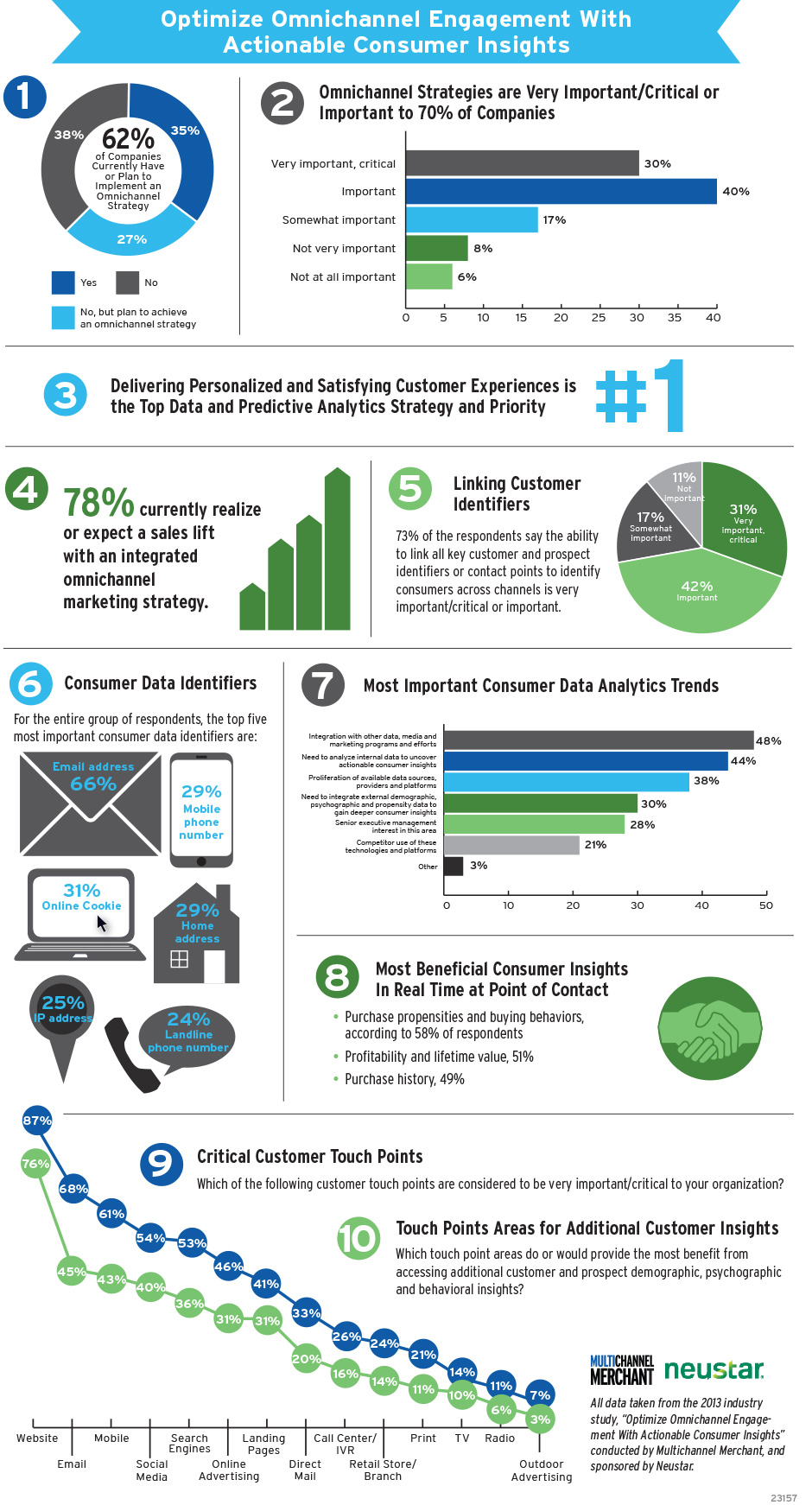
The reason why Omni Channel marketing has evolved as an extremely scientific and mathematically lucrative method is because of the emergence of predictive analytics technology as well as the ability to leverage customer data. The infographic from Neustar underscores my opinions on the advantages of omni channel marketing. According to the infographic, 40% of the companies sampled, stated that omni-channel marketing is important to their companies and 78% of the businesses realize the importance of omni channel marketing in today’s world.

optimize-omnichannel-marketing-infographic

Omni channel is not the same as multichannel.

Multichannel experiences are what most businesses currently employ in their marketing strategies. These businesses have a website, blog, social media profiles, and other traditional channels for marketing and sales. These are all used to communicate, educate, and market to their current customers and potential new leads.The problem is that these channels are often used separately, and can lack unity and consistency as a result. There is no seamless experience for the target audience.That is where an omni channel experience can improve on multichannel. Omni channel strategies take into account all devices, platforms, and contexts of the customers experience. These insights are then integrated with several marketing platforms to create an omni channel marketing experience.

To understand the concept of omni channel marketing, let’s study an example to help us understand the concept better and dissect its positives and negatives as well as how innovative this concept is.

Apple is the first company that popped in my mind as the perfect example of creating a unique, omni channel marketing experience. When we use an Apple laptop , find the product online, or walk into an Apple store, we know exactly what your experience is going to be – a sleek, simple, classy experience. The feel of the brand is seamless across the different channels and that’s what makes it a pioneer of omni channel marketing.

apple-omnichannel-example

According to Invoca, there are four pillars of omni channel marketing: visibility, measurement, personalization and optimization.

Visibility:  Marketers need to focus on the right set of tools that allow them to have complete visibility into the entire customer journey — From first interaction to completed sale, and everything in between.

Measurement: Give proper credit where credit is due,  to optimize your marketing efforts, and to provide a one-to-one, personalized customer experience.

Personalization: Integrate online and offline behaviors into your automation tools to create the most successful omni channel customer experience.

Optimization: Optimize marketing with complete insight into the online and offline impact to make more powerful optimizations and smarter decisions.

Hence, Omni channel marketing is innovative because it has transcended beyond multi channel marketing due to the complex behavior of the target audience who constantly switch devices and consume the same data from different media. The pluses for an omni channel marketing strategy cannot be over emphasized, the advantage it that helps create a brand for the company and position it in a unified manner in the minds of the consumer.I cannot think of any disadvantage other than a cost implication for the brand. Companies have to now spend a ton of money on creating brands that project the same image in the stores , on the apps , on the website or even the catalog- it is all about enhancing the brand experience, but with a price tag, is it worth it? Yes, of course. It is not a fad, it is a concept with solid, steel foundation and must be understood and implemented correctly by marketers. I would highly recommend creating this omnipresent omni channel marketing experience, because every great brand that projects itself as a culture  and not a company is creating this smooth transition experience – be it Starbucks, Anthropologie or even Amazon.

How Big Is Big Data?

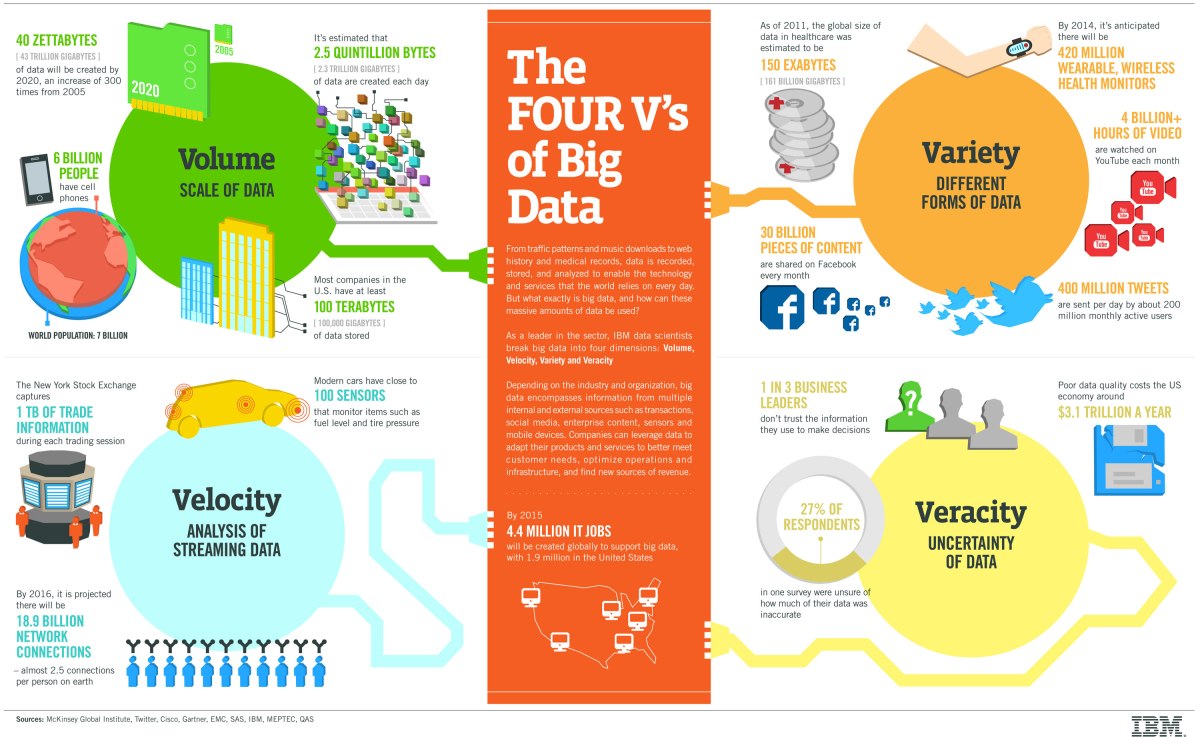
Companies glean a wealth of information about target markets and their behavior from their online activity, point-of-sale transactions, loyalty programs and public domain databases. However, simply accumulating data is not enough to gain a competitive edge. To do so, data must be used strategically, which is why big data is being leveraged by corporations of all sizes. IBM underscores the four V’s of big data namely :Volume, Velocity, Variety and Veracity in the info graph given below, each of which is undeniably crucial.

ibm-big-data

Traditionally, big data has been gathered and analyzed by the business intelligence units of companies, but the trend now is towards democratizing data in organizations so that all departments can develop strategies based on the analytics and insights available to them.

The Vice President of Prudential, Mark Hug came for a lecture to our class at NYU and explained the importance of big data in every industry in today’s world. He pointed out how he is working towards using big data to provide an estimate of insurance premium to its customers without the complicated process of conducting medical tests as well as making expensive trips to the houses of the insurance seekers. He said that the customers will only have to provide their social security numbers and the company would give an estimate within a couple of seconds. This has been made possible only because of the fact that Prudential would have a mammoth of big data – access to every transaction made by the consumer, the websites visited, the logs of the bills at medical stores, doctor visits as well as purchases made at grocery stores. This data directly correlates to the medical conditions of the insurance seeker and would thus help in estimating insurance premiums. This is the power of big data. Hence, big data helps understand consumer behavior, in order to create constructive, long lasting, strategically focused marketing strategies that are results driven and goal oriented.

My concern with big data is privacy. It makes me feel like someone is invading my privacy all the time and nothing, virtually nothing is personal. Whether companies use this data to retarget ads or even use data to provide me information about what I could also like to buy after making a purchase on Amazon, it makes me feel predictable and that’s also what I don’t like.

Screen Shot 2016-04-16 at 7.20.54 PM

We cannot trust every bit of data because there are several metrics behind every transaction, search or purchase made online. May be I read up about cancer for my friend, may be I purchase medicines for my aunt, may be someone else accesses my laptop – there are too many dynamics to the diverse transaction, so data cannot and should not be analyzed independently. One needs to articulately combine data with personal judgment, analysis , past experience, competitive landscape as well as a degree of intelligence and gut in order to take prudent marketing decisions. Hence, I believe one cannot take decisions only based on past data, it needs to be correlated with other parameters, keeping the future changes in demographics and psychographics in mind.

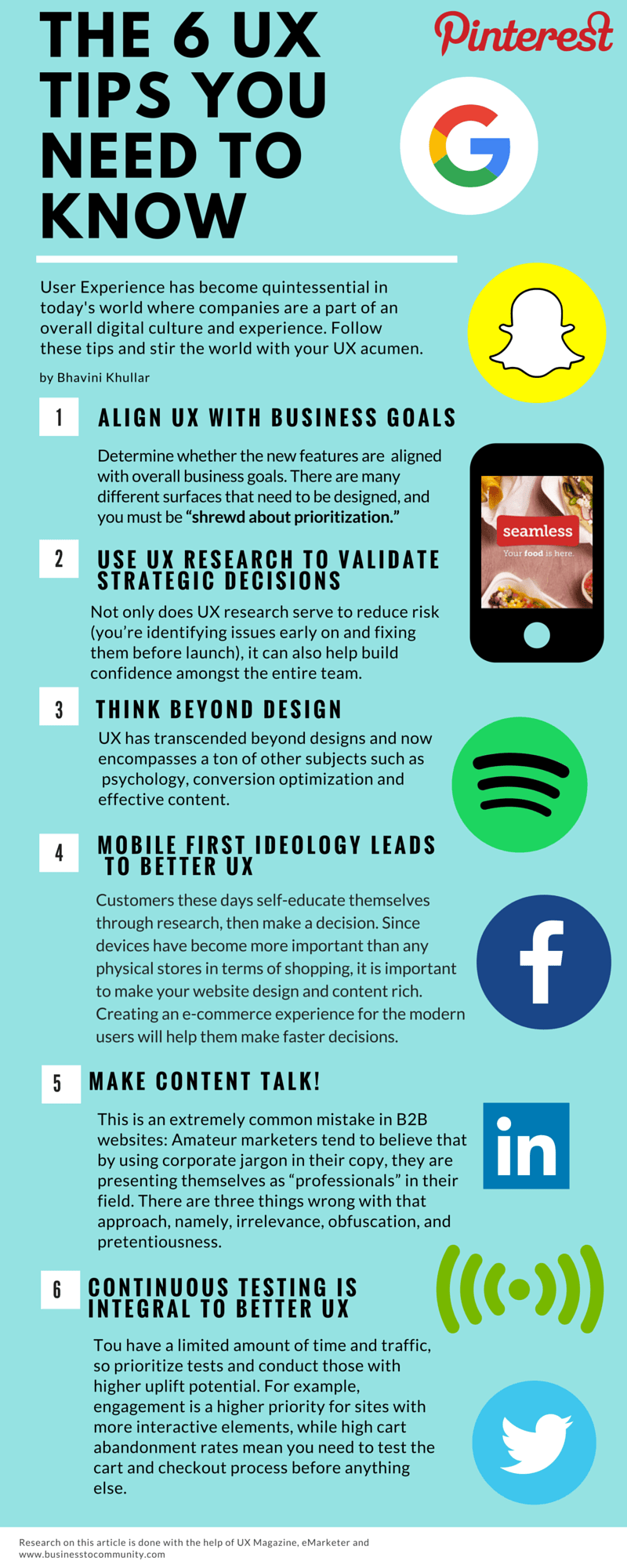
6 Handy Tips To Master your UX

User Experience has evolved as a great marketing tool to increase conversion rates of customers. This is because User Experience has surpassed the narrow scope of design and has evolved several other forms of creativity such as content, gamification, usability, the use of the company culture.

Brands like Google, Pinterest, Facebook , Twitter, Lyft, Seamless have pioneered the art of UX making the experience effortless and meaningful. Here are a few tips to follow to broaden your understanding of  UX and enable you to add more meaning to your customer experience as a whole.

The 5 best UX lessons

Aligning user experience with business goals is key. It is very important to project user experience as an extension of the company culture. Extensive research must be conducted based on demographics, psychographics, choices, preferences and only then should the new features be launched. For example,Lyft conducted several focus group researches to conclude the inclination people had with the color Pink and that’s why the App is such a roaring success. Seamless had conducted extensive research on the font , color and the app layout before the launch mainly because they knew the psychographics of the customers who lack time and concentration due to their fast paced lives and would need an easily navigable website and app.Content is now pivotal to a website or an app, it was additional benefit the company has to offer.

I was reading an article the other day that said understand what you have to offer to your clients excluding the product or services offered by the company. This left an indelible imprint in my mind as it made me ponder and realize the importance of content and the role it plays in educating the minds of the users.These are some of the tips I found most useful, I hope they will hone your UX expertise and help you create brands that assimilate into the interconnected, ever-evolving digital culture of today’s world.


Paid Digital Media: Benefit Cosmetics

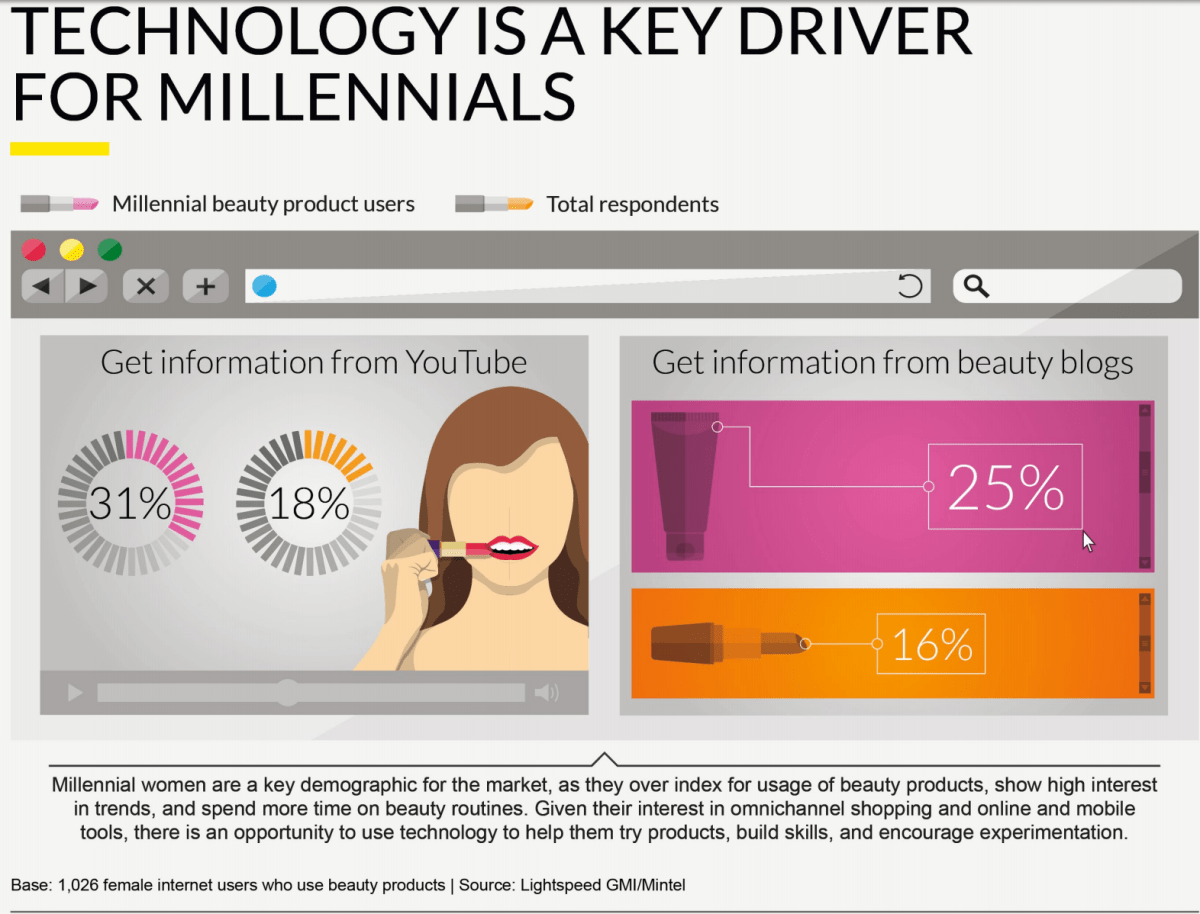
The world is evolving into a web of connected buyers who rely on one another for views, reviews , opinions about several products and brands. Make-up occupies a quintessential role in the lives of the millennial women, who compromises of 42% of the American population. This niche target audience of make-up brands is primarily glued to social media, which is why most of the make-up companies are capitalizing on this niche target audience.

 Screen Shot 2016-04-02 at 12.58.47 PM.png
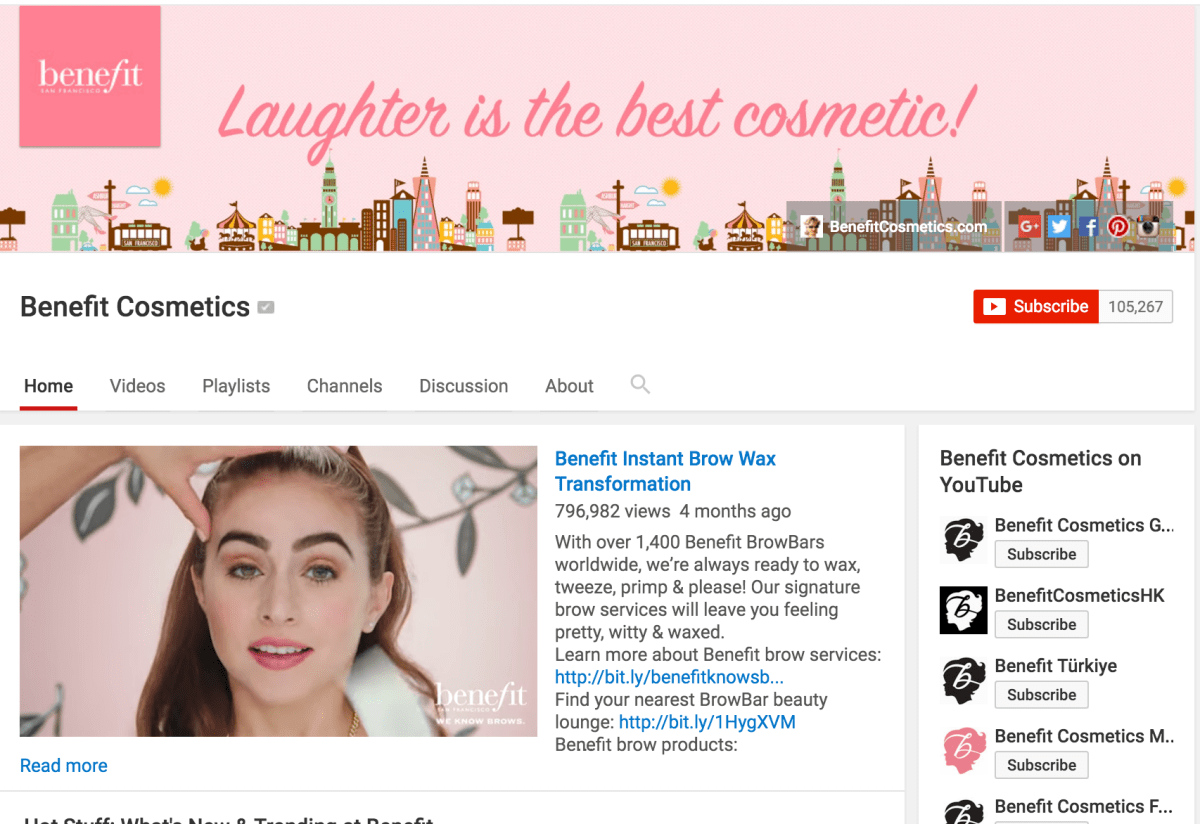
This cosmetic brand has pioneered the world of digital landscaping in the makeup industry. YouTube influencers are riding the wave for Benefit Cosmetics. Despite the 105,267 subscribers of its dedicated YouTube Channel, its YouTube influencers have a greater reach and hence, bring more impressions to the website. According to Alison Haljun, Vice President, Retail Marketing and PR at Benefit Cosmetics, the Company allots less than 10% of what it spends on its dedicated channel to the influencer bloggers and vloggers. It however, continues to spend on its YouTube Channel to bolster the strength of the brand. Another reason for this mismatched budget allocation is that the content shared on the dedicate YouTube Channel, is often shared by these YouTube influencers , hence magnifying the impact of its paid social media advertising on YouTube. The top YouTube bloggers employed by the company are eleventhgorgeous, Dulce Candy and Manny Mua.
Screen Shot 2016-04-02 at 1.36.31 PM.png
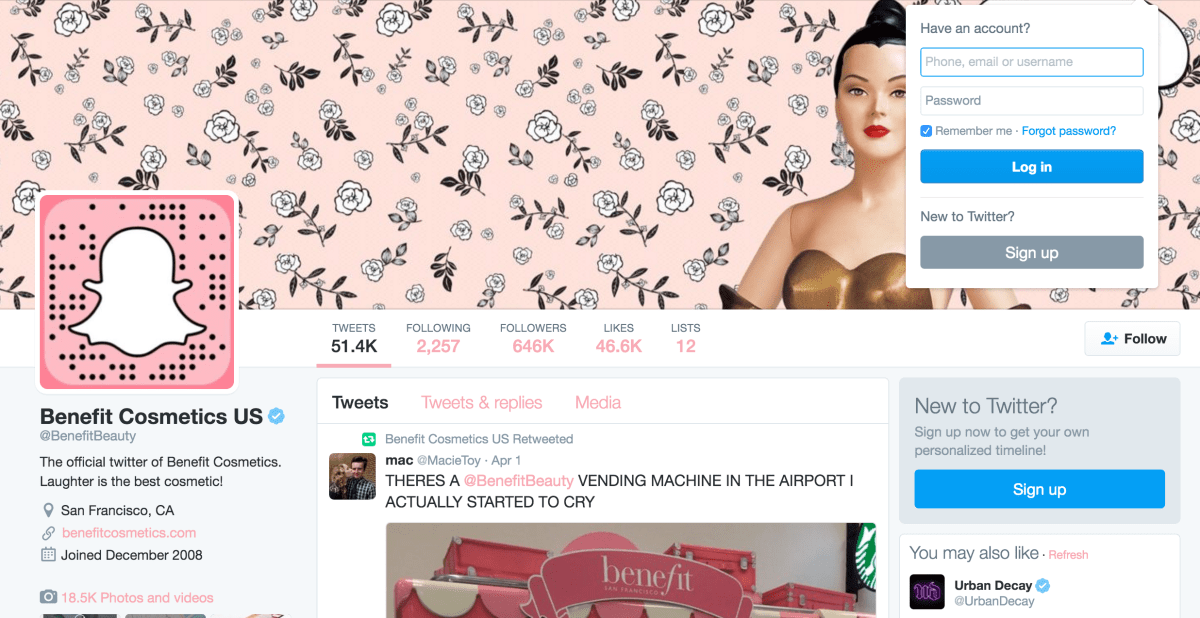
Benefit Cosmetics also uses Snapchat as an interactive tool to demonstrate videos of the latest lines of make-up. What I love about its Snapchat account is that not only does it show videos of its products, it also provides snaps of where these products are available. It does this through by incorporating snaps by the young female millenials, who they pay on commission basis, based on the number of views the snaps receive. It has also partnered with several celebrities that use Benefit Cosmetics in their videos as a means of native advertising by providing heavy sums of money. My favorite actress in India, Alia Bhatt, in fact uses  Benefit Cosmetics in all her videos but the subtlety of the usage of the product is what I love about it the most. The makeup snapchats by Alia, don’t put out make up blatantly and intrigue me to want to know more about its products.
Screen Shot 2016-04-02 at 1.02.04 PM.png
The brand has effectively understood its target audience, studied their psychographics and targeted them through paid digital media in the most efficient manner. In my humble opinion, Benefit Cosmetics has pioneered the digital space and used YouTube and Snapchat in a very proficient manner by integrating it with its Twitter account.